
Last updated November 15, 2026
 AC repair
 Furnace & heating
 Heat pumps
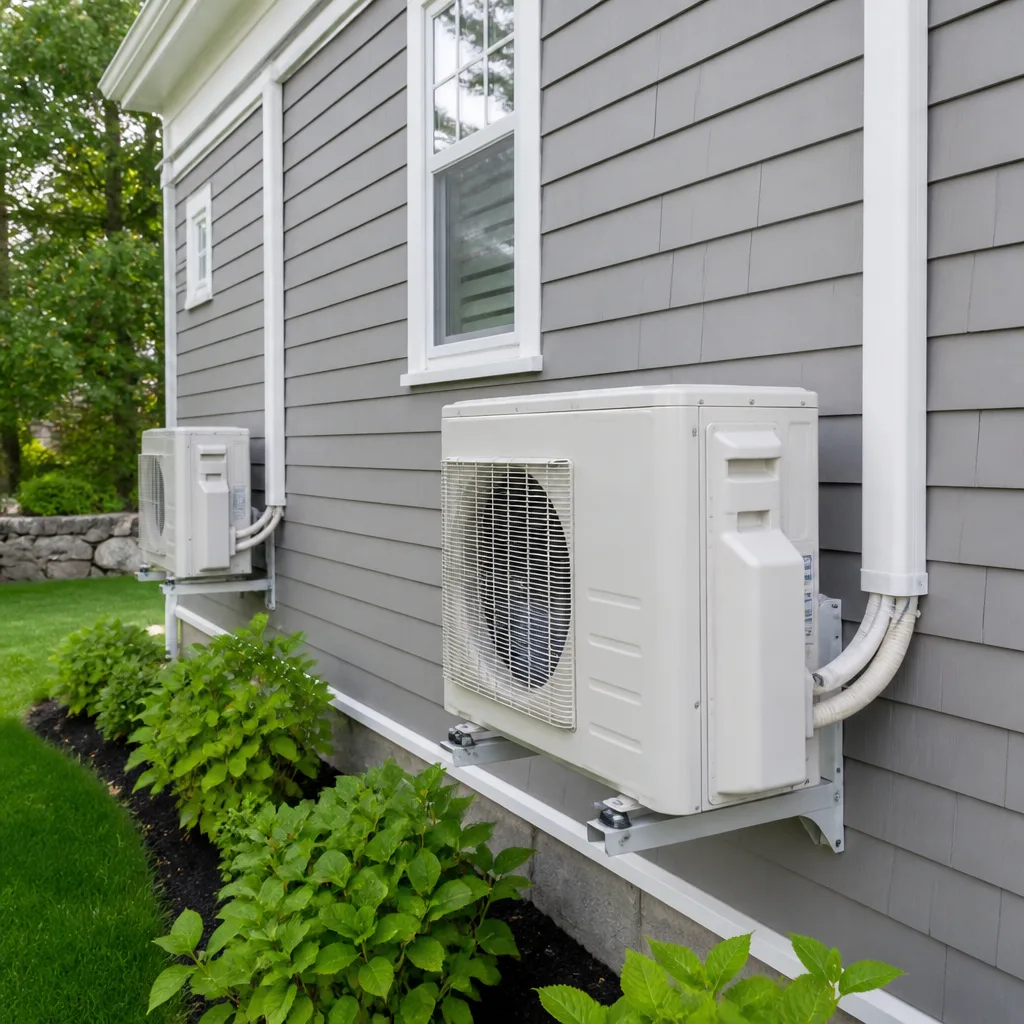 Ductless mini splits
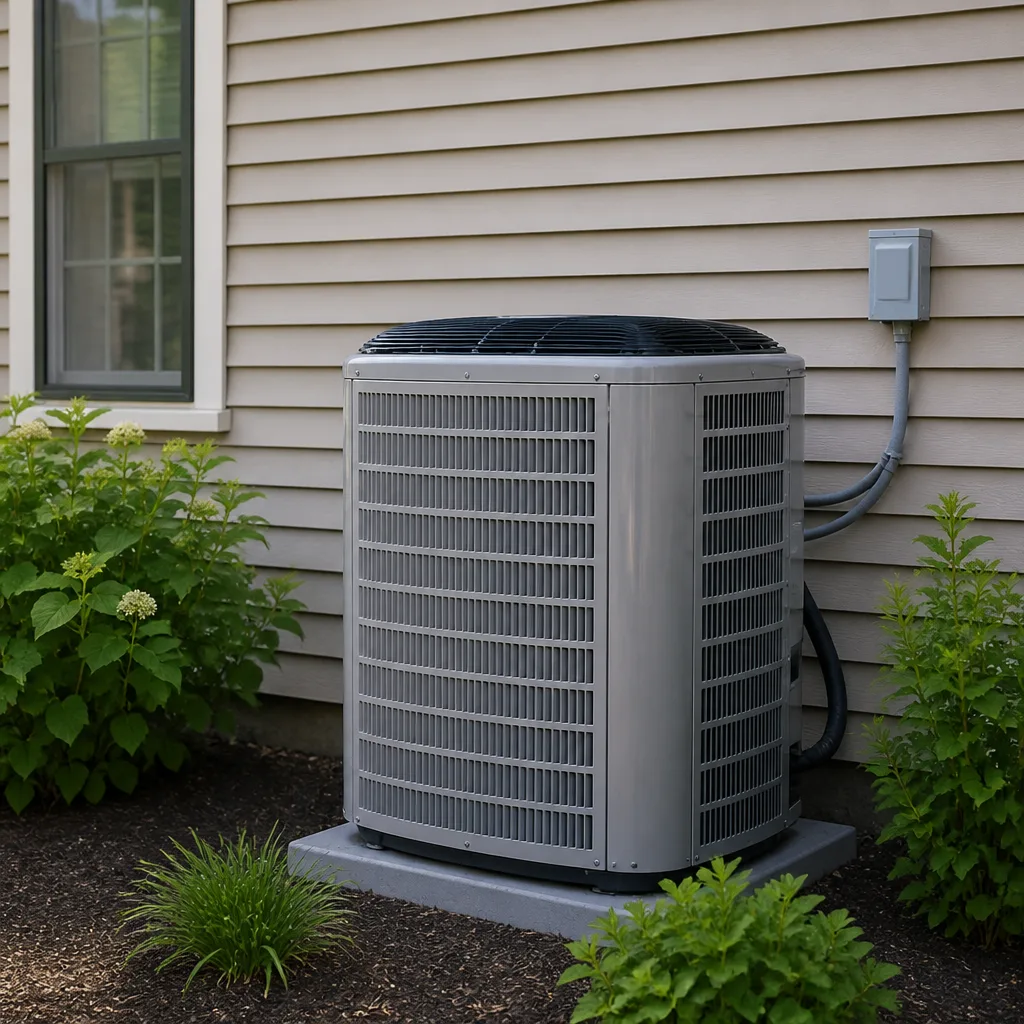 Carrier
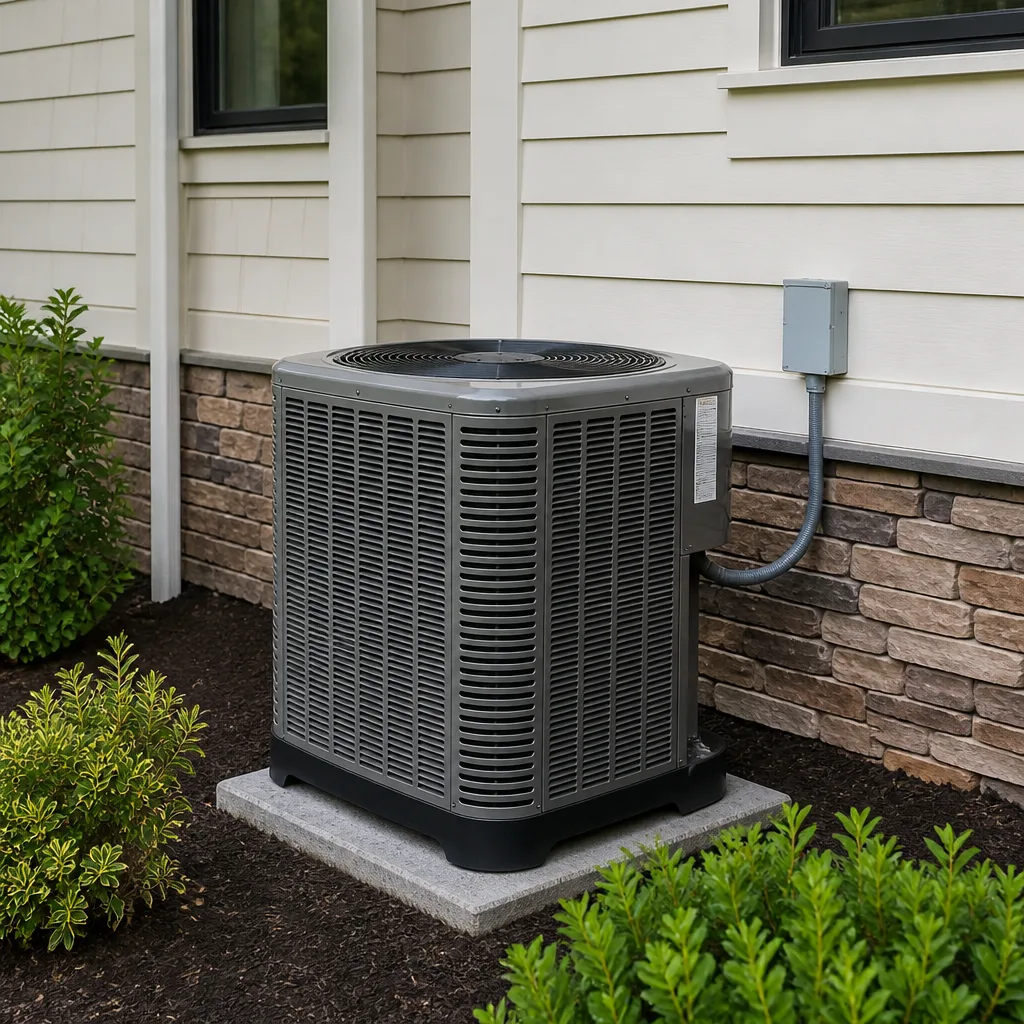 Trane
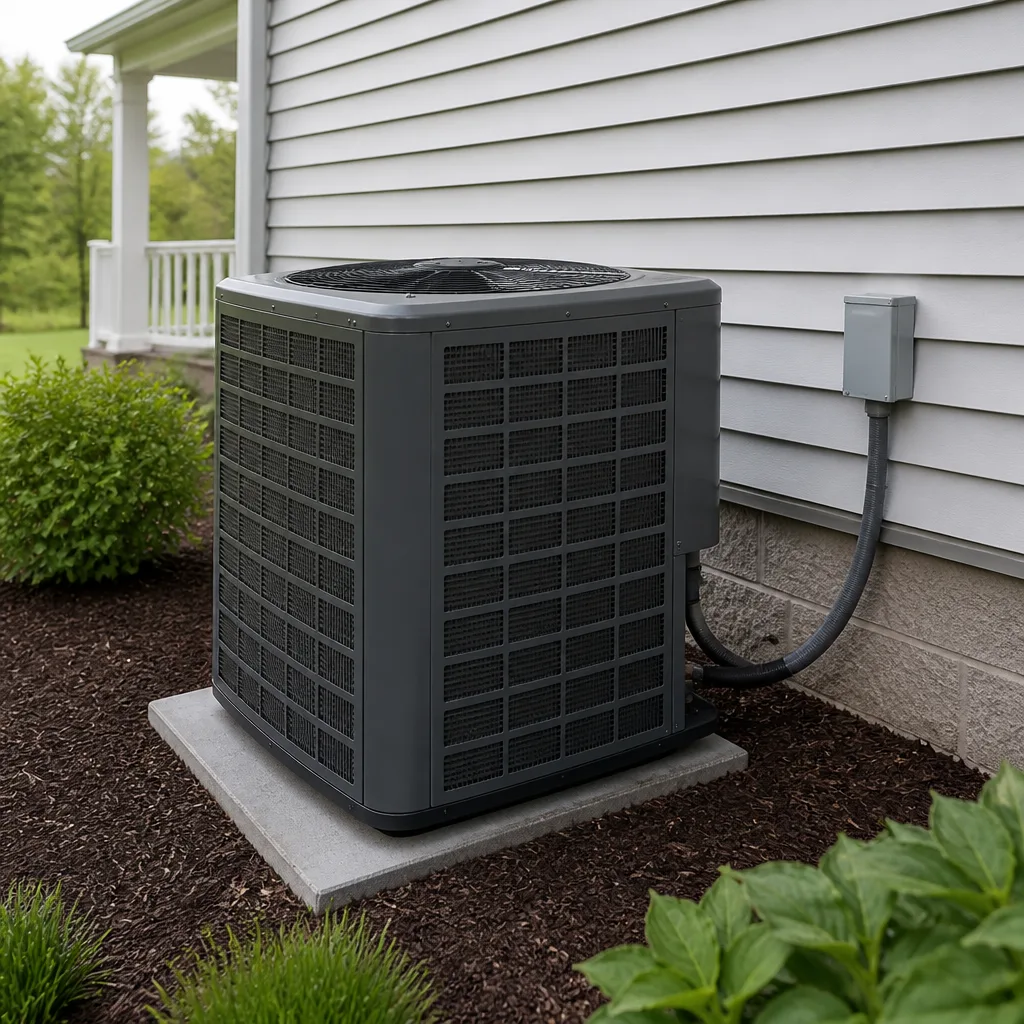 Goodman
Seasonal tune-up and full diagnostic on your Carrier, Trane, or Goodman system - readings shown to you before any repair is proposed
Diagnosis first, numbers second - you approve the repair price before a single part goes in.
Get your free estimateHow to Hire an HVAC Contractor in Boca Raton: A Step-by-Step Guide
In Palm Beach County, a contractor can hold a valid HVAC license and still be contractually bound by a dealer agreement that prevents them from recommending the brand that would actually fit your home best. They aren’t required to tell you about that restriction. This matters more than most hiring advice admits, because the standard script (“get three quotes, read reviews”) can’t see a dealer tie, a skipped permit, or a load calculation that was never done. This guide walks through how to check a Florida license in about three minutes, which questions expose a single-brand dealer, and what a proper Manual J report should look like on paper. You’ll leave with a checklist you can take to any estimate in Boca Raton.
Quick Answer
To hire an HVAC contractor in Boca Raton, verify their state license through the Florida DBPR, confirm they’ll pull the Palm Beach County permit, ask for a written Manual J load calculation before any equipment is quoted, and ask which brands they’re authorized to service and recommend. A genuine multi-brand technician answers questions about competitors’ equipment without hesitation. A single-brand dealer points everything back to the one line they’re tied to.
Styles & brands we work with
- AC repair
- Furnace & heating
- Heat pumps
- Ductless mini splits
- Carrier
- Trane
- Goodman
Table of Contents
- How Do You Verify an HVAC Contractor’s License in Florida?
- What Five Questions Separate a Multi-Brand Technician From a Dealer?
- Why Is the Lowest Bid Often the One Without a Permit?
- What Does a Proper Manual J Load Calculation Look Like?
- What Red Flags Are Specific to the Boca Raton Market?
- What Should a Real Written Estimate Include?
- How Do Equipment and Labor Warranties Differ?
- When Is Repair the Right Call Over Replacement?
How Do You Verify an HVAC Contractor’s License in Florida?
You verify an HVAC contractor’s license in Florida by searching their company or individual name on the Florida Department of Business and Professional Regulation (DBPR) website. The search takes about three minutes and returns the license type, status, and disciplinary history. Florida licenses HVAC contractors under the CAC classification (Certified Air Conditioning Contractor), and the record shows whether that license is active, null and void, suspended, or restricted.
What a problem record actually looks like is worth understanding before you start. “Active” is what you want. “Null and void” usually means a license lapsed for failure to renew, and a contractor working under a lapsed license can’t legally pull permits. “Suspended” is a disciplinary action. “Restricted” means the contractor can operate only under defined limits, sometimes with a supervising contractor signing off. Any of those statuses should end the conversation, no matter how polished the estimate looked.
The DBPR record also shows whether a business has a complaint history. A single closed complaint with a resolution isn’t cause for alarm. A pattern of complaints about incomplete work or permit issues is. Read the disposition, not the count. And check that the name on the license matches the name on the contract you’re asked to sign, not just the name.
One detail people miss: the qualifying agent. A licensed HVAC business has to have a qualifying agent (usually the person who holds the CAC) tied to the license. If the person quoting your system isn’t the qualifier and the company name doesn’t match the DBPR record, slow down and ask who will pull the permit and carry the insurance. Getting this straight before signing is the single cheapest step in the whole hiring process.
What Five Questions Separate a Multi-Brand Technician From a Dealer?
Ask about competitors’ equipment and listen for how the answer is framed. A technician who is factory-familiar with multiple brands explains the differences plainly. A single-line dealer steers every answer back to the one brand they sell and frames every other brand as a compromise. Here are the five questions, and what a genuine answer sounds like.
- “Do you service Carrier, Trane, Lennox, and American Standard, or just one of them?” A multi-brand company names the brands it works on. A dealer names one and changes the subject.
- “If my existing system is a brand you don’t sell, can you still repair it and get parts?” The honest answer is yes, within reason. If they say no, or say the parts are hard to get and you should replace, that’s a dealer talking.
- “What would you put in a 1,600-square-foot home with west-facing glass, and why?” A real technician asks follow-up questions: ceiling height, insulation, window type, duct condition. A dealer quotes a size and a brand before asking anything.
- “What’s the difference between a two-stage and a variable-speed compressor, and which fits this house?” A technician explains both and then tells you which one your home’s load actually justifies. A dealer pitches the premium model regardless of load.
- “If I asked you not to install a new system and just repair what I have, would you?” The right answer is that repair is on the table whenever it’s the better call. If the only path forward is replacement, you’ve learned what you needed to know.
We work on your system, not just the brands we sell. Whether it’s your Carrier AC or your Goodman furnace, we know it, and that familiarity is what lets us tell you when a repair is the honest answer and when replacement is. Nine major brands. One call. That’s the model a homeowner in Boca Raton should be looking for, whatever company ends up doing the work.
Why Is the Lowest Bid Often the One Without a Permit?
The lowest bid in Boca Raton frequently reflects a contractor skipping the Palm Beach County permit, and that has downstream consequences for your homeowner’s insurance. A permit means an inspection, and an inspection costs the contractor time. Some shops cut it. When they do, the installation goes in without a recorded inspection, and that gap can surface years later when you sell the home or file a claim.
Whether you need a permit for a given HVAC job depends on the scope and on your municipality’s rules, so ask the contractor directly and confirm with the city or county building department. As a general rule, replacing a system or making significant modifications to the refrigerant circuit or ductwork typically requires one. Swapping a compressor or a control board usually doesn’t. Don’t take our word for the line between those. Ask the building department. The point is that a contractor who avoids the question is telling you something.
Here’s what a permit buys you:
- A recorded inspection of the installation, which surfaces problems while the contractor is still on the hook for them.
- Documentation that the work was done to code, which matters when a buyer’s inspector or your insurer asks for it.
- A paper trail that an unpermitted install doesn’t have. Unpermitted work can complicate a claim if a failure traces back to the install.
- Proof that the contractor was willing to be inspected. That alone filters out a certain kind of shop.
If a bid is meaningfully lower than the others and the contractor can’t explain exactly what they’re leaving out, assume the permit is the missing piece. Ask them to put in writing that they’ll pull it. If they won’t, you have your answer.
What Does a Proper Manual J Load Calculation Look Like?
A proper Manual J load calculation is a room-by-room report that estimates how much heating and cooling your home actually needs, based on square footage, insulation, window area and orientation, ceiling height, air infiltration, and local design temperatures. It’s the industry-standard method, and a contractor who skips it is guessing at equipment size. Guessing is how homes end up with a system that’s too large, short-cycles, and never removes the humidity that makes a Palm Beach County summer feel worse than the thermometer says.
Ask to see the report before you sign anything for a new system or a major change. On paper, it should include:
- Room-by-room or zone-by-zone square footage with ceiling height noted.
- Window and door counts, with orientation (north, south, east, west) and whether glazing is single or double pane.
- Insulation values for walls, attic, and floors, or the assumed values if the contractor didn’t measure.
- Local design temperatures used for the calculation. For our area, the summer design condition should reflect the actual heat and humidity we get, not a national default.
- A resulting tonnage recommendation for the home, not just a model number.
- If ductwork is involved, a Manual D or at least a duct sizing review, because the right equipment on undersized ducts still underperforms.
Boca Raton homes vary widely. A 1970s ranch near Downtown with original single-pane glass carries a very different load than a newer build out toward the western communities with impact windows and modern insulation. Two homes of the same square footage can need different tonnage. That’s why a contractor who quotes by rule of thumb (“about a ton per 500 square feet”) is making an assumption, and why the written Manual J is a legitimate thing to require before you spend money on equipment.
If you’re moving toward replacement, see our page on AC installation for what the process looks like from sizing through startup. It’s the same standard we hold on every install.
What Red Flags Are Specific to the Boca Raton Market?
The most common red flag in Boca Raton is the “free tune-up” that turns into a replacement pitch. These offers are sometimes real maintenance and sometimes a sales appointment wearing a service-tech shirt. If a technician arrives for a free tune-up, spends twenty minutes, and then tells you the system is failing and needs replacement before the cooling season, get a second opinion before you act. A system that cools and heats can usually be repaired. Ask what specifically failed, ask to see it, and ask what the repair would cost.
Here’s what else to watch for in this market:
- Replacement-first diagnosis. A shop whose business model is system sales will find a reason to sell you a system. A repair-first shop will give you the repair option and its cost before mentioning replacement.
- Brand lock-in masquerading as expertise. “We only install X because it’s the best” is a dealer talking point, not a technical judgment. A contractor who works on one brand can still be competent, but they can’t give you a fair comparison across equipment.
- No Manual J, no permit, no written scope. Any one of these is a warning. All three together is a pattern.
- Pressure to decide today. Equipment ordering, permitting, and scheduling take time. A same-day-decide-or-lose-the-price pitch is a sales tactic, not a scheduling reality.
- Vague warranty terms. “Fully warrantied” isn’t a warranty. Ask for the written terms, including labor coverage and whether the warranty transfers if you sell the home.
- The handoff. If the company that services your AC won’t touch your furnace, you’re managing two contractors and two sets of records. That’s a structural problem in a home that needs both.
For a deeper look at how furnace work fits into the picture, our furnace repair page explains what a repair-first visit covers and where replacement becomes the right call. The point for hiring purposes is simpler: a contractor who covers both cooling and heating can’t hand you off, and that’s worth something.
What Should a Real Written Estimate Include?
A real written HVAC estimate is itemized, names the equipment model numbers, states the permit responsibility, and puts the price in writing before work begins. If you can’t tell from the estimate what you’re buying and what’s included, it isn’t done. The written estimate is also where the final price is set. Verbal quotes, texts, and “about” figures are conversation, not commitments.
Before you sign, confirm that the estimate includes:
- Equipment specifics. Model numbers for the condenser and air handler or furnace, with tonnage and efficiency ratings named, not just “a 3-ton system.”
- Scope of work. What gets removed, what gets installed, what gets reused. Line-set replacement, drain-line work, pad, and disconnect are all items that some shops include and others don’t.
- Permit statement. Who pulls the permit and who pays for it. If it’s not mentioned, ask.
- Load calculation reference. The tonnage should trace back to a Manual J, not to the size of the old unit.
- Warranty terms in writing. Manufacturer equipment warranty and the contractor’s labor warranty, with lengths and exclusions spelled out.
- Payment terms and schedule. Deposits, progress payments, and the final payment tied to a working system and an inspection where applicable.
- A fixed price. For installation and replacement work, a set price in writing beats an open-ended estimate. The estimate sets the final price, and nothing gets added without your approval.
We give free estimates and put the price in writing before anything is ordered. When you’re ready to compare, call Tidewater AC Repair at (855) 552-3403. We answer 24/7. Fast dispatch from 7am to 7pm, Sunday through Friday.
How Do Equipment and Labor Warranties Differ?
Equipment warranties come from the manufacturer and cover parts. Labor warranties come from the contractor and cover the work of installing or repairing. They’re separate documents and they cover different failures, which is why “fully warrantied” on a quote means little until you see both. A failed compressor under a manufacturer warranty can still leave you paying labor if the contractor’s labor coverage is short or the failure is excluded.
What to check on the equipment side: the parts coverage length, whether it’s registered in your name (some manufacturers require registration for the full term), and whether the warranty transfers to a new owner if you sell the house. On the labor side: how long, what’s covered (diagnosis, refrigerant, access), and whether the contractor honors it on a system they didn’t install. Many companies won’t warranty work on equipment another company put in. That matters when your contractor relationship changes.
Ask a direct question: “If the compressor fails in year three, what do I pay?” The answer should be specific. If it isn’t, the warranty isn’t as good as the brochure. And ask the same about a repair: what’s the labor warranty on a repair job if the same part fails again soon after. Straight answers here are a decent proxy for how the company handles problems generally.
Because a home in Boca Raton needs both cooling and heating over its life, the warranty story should cover both. A cooling-only shop can honor an AC warranty but can’t help with a furnace failure, and vice versa. Cooling and heating under one roof means no seasonal gap in your coverage or your service records.
When Is Repair the Right Call Over Replacement?
Repair is the right call when the system is cooling or heating, the repair cost is a modest fraction of replacement, and the equipment is in the earlier part of its service life. Replacement is the right call when failures are recurring, the repair is major (compressor, coil, heat exchanger), the equipment is near or past its expected service life, or the system was never sized correctly to begin with. The condition of the equipment and the cost of the repair are the two facts that decide it, not the age alone.
Work through it in order:
- Is it actually failing, or is it a control or airflow problem? A dirty filter, a failed capacitor, a stuck contactor, or a blower issue can look like a dying system from the thermostat. Diagnose first, replace second.
- What’s the repair cost versus the system’s remaining useful life? A common repair on a system in the first half of its life is an easy yes. A major component repair on an old system is worth a hard conversation.
- Is the system the right size? If it was oversized or undersized from the start, repairing it just extends a problem you’ll solve sooner or later.
- Is the ductwork healthy? Undersized, leaking, or poorly sealed ducts cause comfort problems no new condenser will fix.
- What does the written comparison say? Repair cost now, expected life left, replacement fixed price, and what the replacement includes (equipment, permit, startup). If the comparison is clear on paper, the decision usually is too.
No one can make that call honestly without looking at the actual equipment. A repair-first shop gives you the numbers. A replacement-first shop gives you the pitch. On a hot week in Boca Raton, an AC that’s down is a real comfort problem, and we’ll tell you the fastest path to cool air. Call (855) 552-3403 for an exact quote. Estimates are free.
Common Mistakes to Avoid
- Not checking the DBPR record. A contractor with a lapsed or restricted license can still show up in a clean shirt and a clean truck. The state record is the only thing that tells you the truth about their standing, and it takes three minutes to check before they arrive.
- Accepting a quote without a Manual J. A system sized by rule of thumb is sized by guesswork. In our climate, an oversized unit cools fast and leaves the house clammy. Ask for the load calculation before you sign.
- Choosing the lowest bid without asking what’s excluded. The lowest bid often skips the Palm Beach County permit or leaves out the line set, pad, or drain work. Ask for the itemized scope and compare line by line.
- Treating a “free tune-up” as a service call instead of a sales call. If the tune-up ends in a replacement pitch, ask for the specific failure, ask to see it, and get a second opinion before you commit to equipment.
- Hiring a single-brand dealer and expecting an unbiased comparison. A dealer tied to one line can be honest and still can’t recommend a competitor. If your goal is the right brand for the house, you need a contractor who works on several.
- Accepting a verbal warranty. “It’s warranted” and a warranty you can read are not the same thing. Get the terms in writing, including whether labor is covered and whether the warranty transfers on sale.
- Splitting the work between two companies. One shop for cooling, another for heating means two sets of records, two sets of warranty terms, and neither company will warrant the other’s work. A single contractor for both systems avoids that.
See the difference
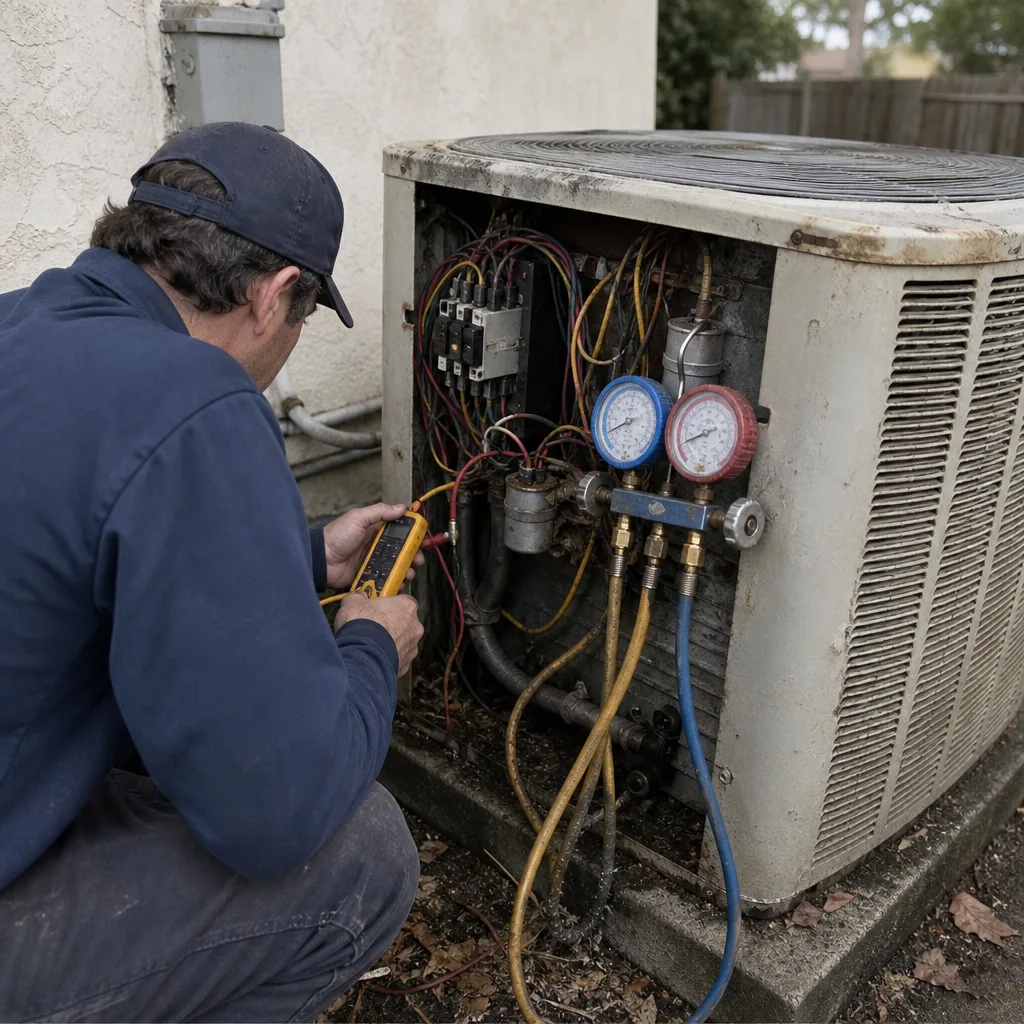 Before
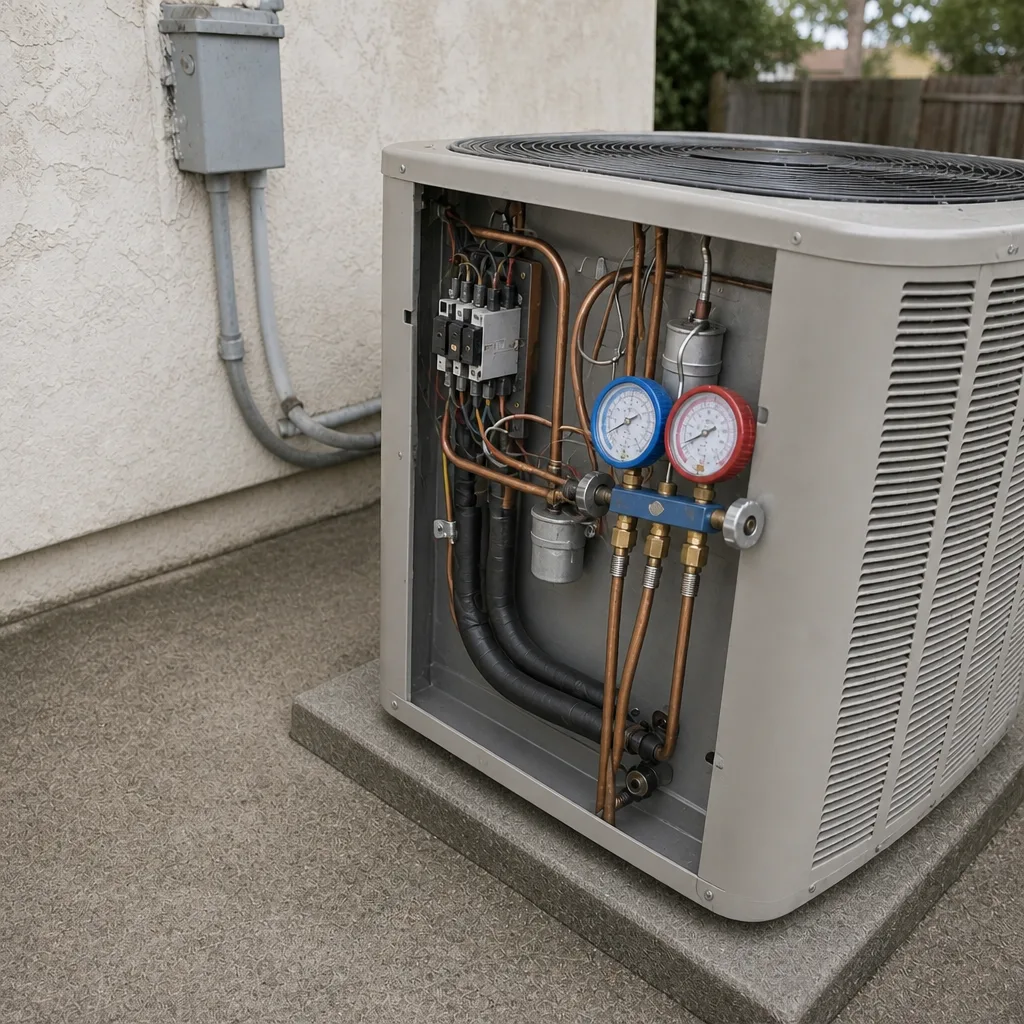 After
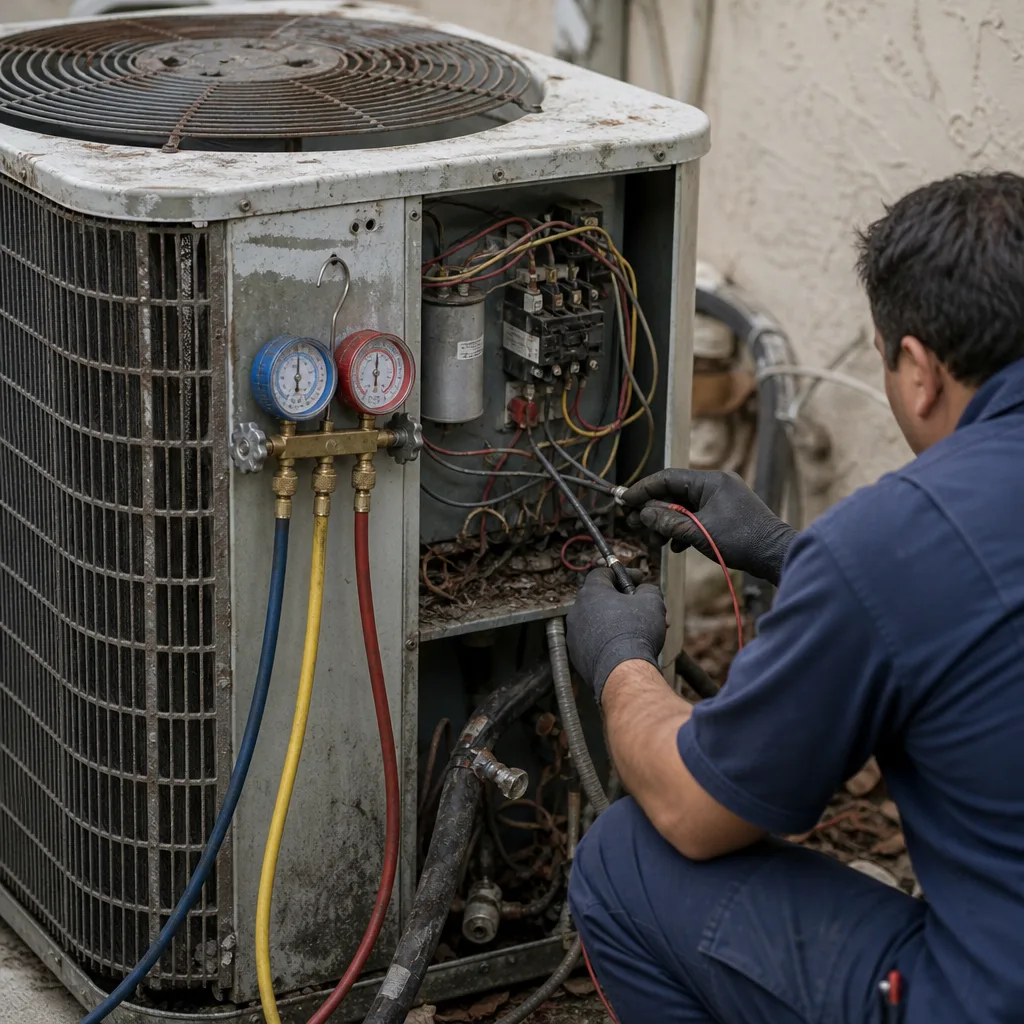 Before
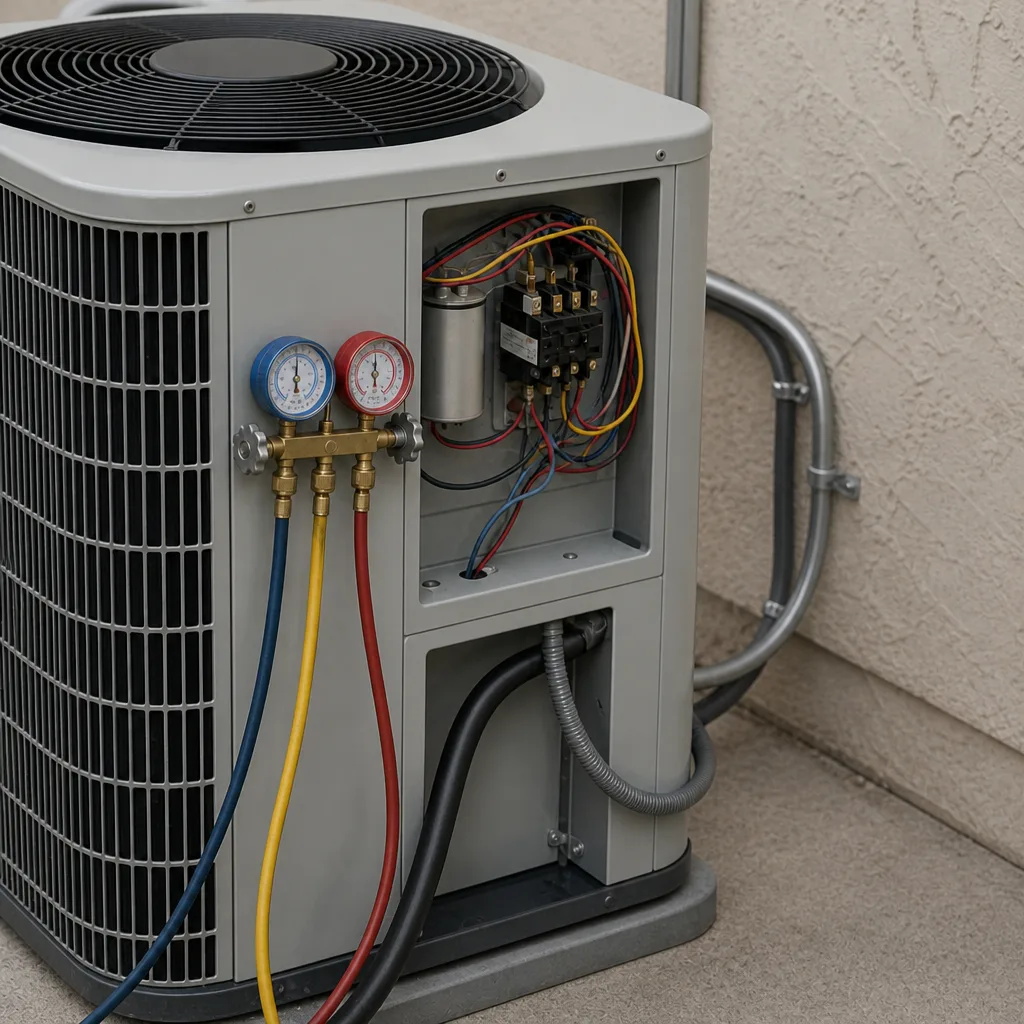 After
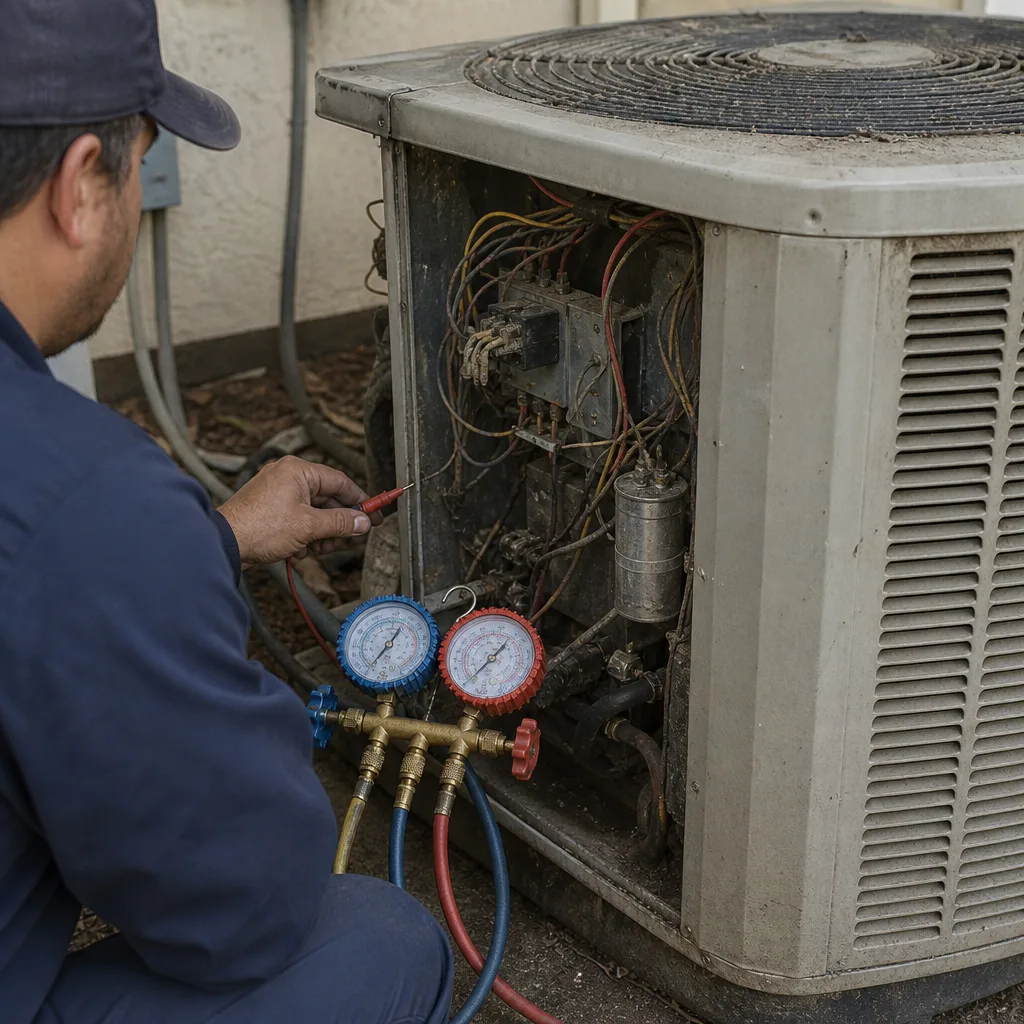 Before
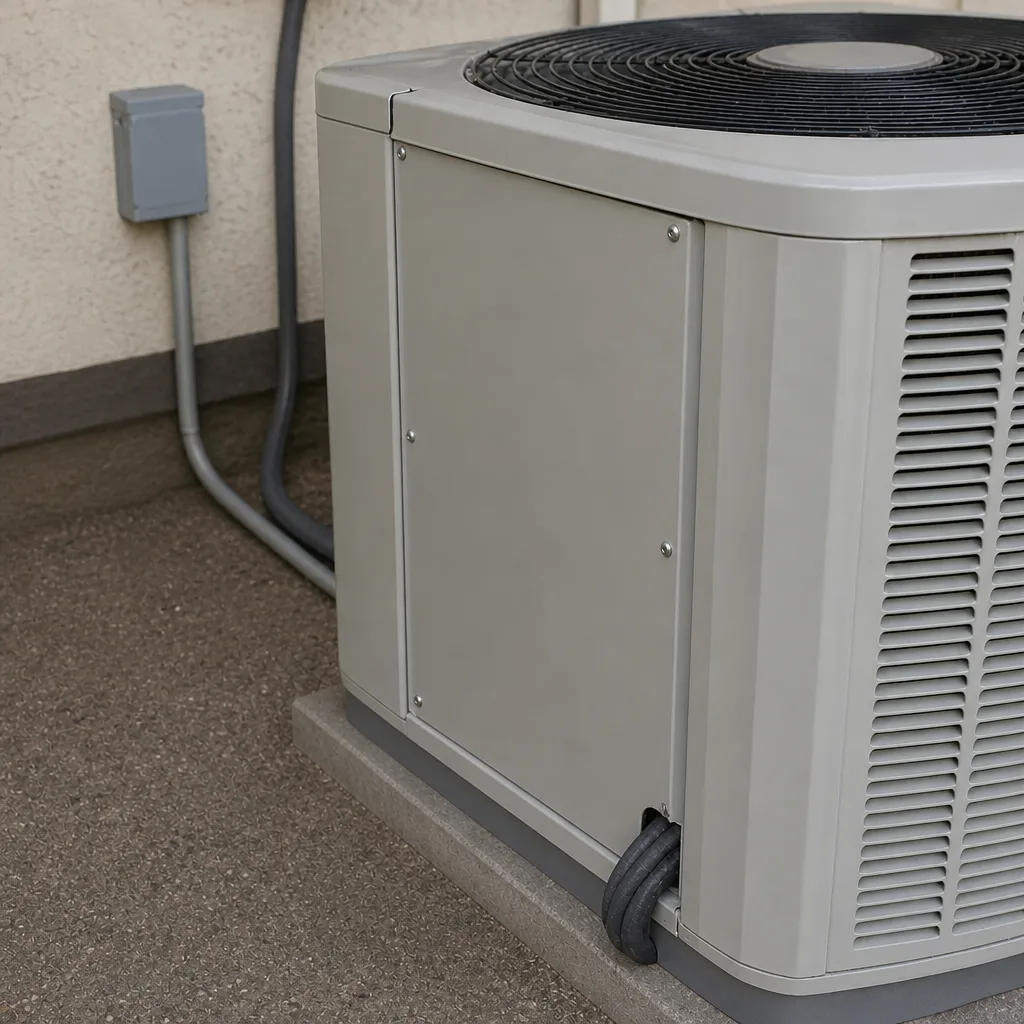 After
When to Call a Professional
Call a professional when the system stops cooling or heating reliably, when you see ice on the indoor coil or refrigerant lines, when the breaker trips every time the unit starts, when the thermostat shows a fault code you don’t recognize, or when you smell burning or exhaust in the equipment area. Call before you decide on replacement, too, so you get a real diagnosis instead of a pitch. And call before you sign a replacement contract if any of the above checkpoints failed: no license check, no Manual J, no permit, no written estimate.
Tidewater AC Repair offers free estimates in Boca Raton, and we handle both repair and replacement with the written price set before work starts. Call (855) 552-3403. We answer 24/7. Fast dispatch from 7am to 7pm, Sunday through Friday, and we’re closed Saturday. A call outside dispatch hours is booked into the next opening.
Frequently Asked Questions
Check the Florida DBPR website for the contractor’s company or individual name and look at the license status. An active CAC license is what you want. “Null and void,” “suspended,” or “restricted” are reasons to stop. Confirm the name on the license matches the name on your contract. Call (855) 552-3403 for an exact quote. Estimates are free.
Most system replacements require a Palm Beach County permit, but the exact rules depend on the scope of work and your municipality, so confirm with your building department. Ask the contractor in writing who pulls the permit and who pays for it. A bid that omits the permit is usually the cheapest bid for that reason. Call (855) 552-3403 to ask how we handle permits on your project.
A Manual J is a room-by-room calculation of how much heating and cooling your home actually needs. You need one before any new equipment is sized and quoted. Without it, the contractor is copying the old unit’s size or guessing by square footage. Ask to see the report before you sign. Call (855) 552-3403 for a written estimate that starts with the load.
Yes, a full-service HVAC company handles both cooling and heating. Hiring one contractor for both systems means one set of records, one warranty relationship, and no handoff between seasons. Ask up front whether the company repairs and replaces both. Call (855) 552-3403 to schedule a free estimate for either system.
Repair is usually the right call when the system is in the earlier part of its life and the repair is modest. Replacement makes more sense when failures are recurring, the repair is major, or the system is near the end of its service life. Get the repair cost in writing next to the replacement cost before deciding. Call (855) 552-3403. Estimates are free.
Ask which brands they’re factory-familiar with and whether they can repair a brand they don’t sell. A multi-brand technician answers without steering you toward one line. A single-brand dealer can’t offer a fair comparison across equipment. Call (855) 552-3403 and ask us about your system, whatever brand it is.
The Bottom Line
The hiring script that works in Boca Raton has four parts: verify the license through Florida DBPR, require a Manual J before any equipment quote, confirm the Palm Beach County permit in writing, and ask which brands the contractor can actually service and recommend. Those four checks filter out most of the ways a homeowner ends up overpaying for equipment they didn’t need or inheriting an install that was never inspected. The lowest bid and the cleanest truck mean little without them. A contractor who works on the system in your home, not just the brands they sell, will answer all four without flinching. Start with a free estimate from a company that does. Browse our Tidewater AC Repair homepage to see our full service list, or read more about our Boca Raton service area. Call (855) 552-3403. We answer 24/7. Fast dispatch from 7am to 7pm, Sunday through Friday.
Written by the team at Tidewater AC Repair.